



Water tank internal coating failure
Issues, assumptions and the missing link of solar heat load
Coating failures on water tanks are often discussed as paint problems.
In reality, many are energy problems that present as coating defects.
This page explains why conventional assumptions fall short, how unmanaged solar heat load drives repeated failures, and why a surface thermal management approach using Super Therm® resolves the root cause where standard coatings cannot.
The common problem we see
Clients report:
- Blistering or delamination of external coatings
- Failures concentrated on one side of the tank
- Recurring defects after repainting
- Linked internal corrosion or lining issues
In Australia and other high-solar regions, failures are frequently isolated to the northern or western wall.
That pattern matters.
The assumptions that dominate coating discussions
When failures occur, most investigations default to familiar explanations.
Assumption 1: “It’s a paint or adhesion failure”
This assumes the coating system is the primary cause.
If that were true:
- Failure would be random or uniform
- Orientation would be irrelevant
- Changing brands would solve the issue
In practice, failures often reappear in the same sun-exposed zones, regardless of coating type.
That points away from adhesion alone and toward an external driver.
Assumption 2: “It’s moisture ingress or osmotic blistering”
Moisture is real, but it is rarely the initiator.
Heat:
- increases vapour pressure
- accelerates diffusion
- magnifies osmotic forces
- turns minor defects into visible blisters
Moisture explains how blisters grow.
Heat explains why they start and where they localise.
Assumption 3: “It’s an internal lining issue”
This isolates the problem to the inside of the tank.
What is often missed is that external heat load directly influences internal conditions by:
- creating uneven shell temperatures
- driving vapour migration
- increasing condensation risk in vapour zones
- intensifying cold-wall effects during cooling cycles
External thermal behaviour and internal corrosion are linked.
Assumption 4: “A thicker or tougher coating will fix it”
Thickness does not block energy.
Most coatings:
- absorb solar radiation
- store heat
- expand aggressively
- then contract rapidly
This repeated movement introduces shear stress, microcracking, and eventual loss of adhesion.
A tougher coating may delay failure, but it does not remove the cause.
What the failure pattern is actually telling us
When coating breakdown:
- tracks the sun path
- concentrates on north or west faces
- appears above the water line
- worsens after hot days followed by rapid cooling
The failure mechanism is thermal cycling driven by solar radiation.
This is not speculation.
It is consistent with documented vessel failures where blistering predominantly occurred on the sunniest aspects and in vapour zone regions.
The tank is behaving like a heat-loaded structure, not a passive container.
The missing variable: solar heat load on the surface
Steel tanks exposed to direct sun experience:
- surface temperatures far above ambient
- rapid heating during peak solar hours
- sudden cooling from cloud cover, wind, or nightfall
This creates:
- repeated expansion and contraction of the steel shell
- pressure cycling at coating interfaces
- thermal gradients through the wall thickness
Standard paints are not designed to operate under this continuous thermal shock even when painted ‘white’ because they don’t manage infrared heat.
Yet most coating specifications do not address heat load at all.
Why competitors could not provide a solution
This is not a criticism of other coatings.
It is a limitation of the category.
Most coating systems are designed to:
- resist corrosion
- provide barrier protection
- adhere under assumed temperature ranges
- be evaluated in controlled laboratory conditions
- lack of thermal knowledge and experience
They are not designed to manage solar radiation energy nor understand what’s happening.
As a result:
- competitors focus on chemistry, not physics
- ignore the energy issues due to lack of understanding of surface behaviour
- failures are treated as product issues, not energy issues
- repainting resets the clock but not the cause
Without addressing heat input, no coating system can remain stable long-term on a highly exposed tank wall.
The correct approach: surface thermal management
If heat is the driver, the solution must:
- prevent solar radiation from becoming heat in the steel
- stabilise surface temperature
- reduce thermal expansion and contraction
- lower internal thermal gradients
- reduce condensation risk inside the tank
This requires managing surface behaviour, not just coating chemistry.
How Super Therm® changes the system
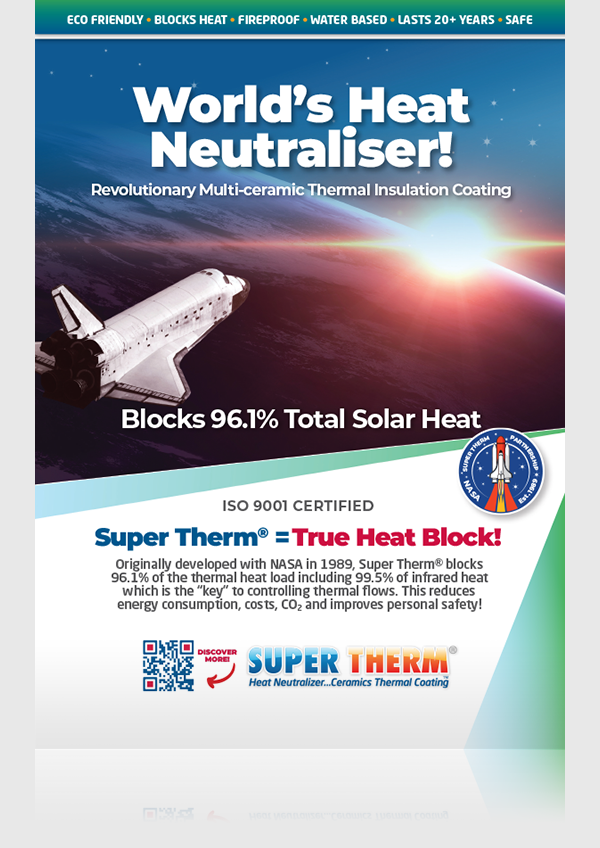
Super Therm® is a multi-ceramic heat-blocking insulation coating designed to control total solar heat load at the surface.
Applied to sun-exposed tank walls, it:
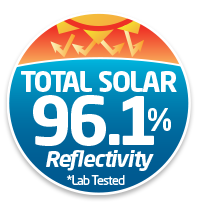
- blocks UV, visible, and infrared radiation
- prevents heat from being absorbed into the steel
- keeps the substrate closer to ambient temperature
- reduces thermal cycling and stress
- stabilises external coatings
- lowers the thermal driver contributing to internal corrosion and lining stress
This is not reflective paint behaviour.
It is radiation heat blocking.
What this solves in real terms
Using Super Therm® as part of the coating strategy addresses:
- blistering isolated to sun-facing walls
- repeated failures despite repainting
- heat-driven delamination
- thermal stress on coatings and steel
- contributing factors to internal condensation and corrosion
It treats the cause, prevents ongoing issues and addresses more than just the damage.
What it does not replace
This matters for credibility.
Super Therm® does not:
- excuse poor surface preparation
- override incorrect application practices
- repair internal linings that have already failed
Good coating practice still matters.
Heat management allows good practice to succeed.
The takeaway
If a water tank coating keeps failing in the same sun-exposed areas, the issue is not mysterious.
It is unmanaged solar heat load.
Until heat is controlled at the surface, coatings will continue to blister, delaminate, and fail – regardless of brand.
That is why conventional competitors have no answers.
They were never addressing the energy due to a lack of experience.
Super Therm® provides a solution because it changes the thermal behaviour of the surface itself with experience since 1989.
Failure Mode vs Mitigation
| Observed Failure Mode | Common Assumption | Actual Mechanism | Why Conventional Coatings Fail | Effective Mitigation Strategy |
|---|---|---|---|---|
| External blistering on sun-facing tank wall (north/west) | Poor paint quality or adhesion | Solar radiation causes extreme surface heating followed by rapid cooling, creating repeated expansion/contraction and pressure cycling | Standard paints absorb and store heat, increasing thermal stress regardless of chemistry | Block solar radiation at the surface to prevent heat ingress using Super Therm® |
| Blistering concentrated above immersion line | Moisture ingress or vapour exposure | Vapour zone experiences highest thermal swings and pressure differentials due to sun exposure | Paints are tested under stable temperatures, not cyclic thermal shock | Reduce surface temperature and rate of change to stabilise vapour zone behaviour |
| Repeated failure in the same location after repainting | Application error or bad batch | Root thermal driver remains unchanged, so stress is reintroduced | Repainting resets appearance but not energy input | Remove the thermal driver rather than changing coating brands |
| Osmotic or hydraulic blistering | Water permeability of coating | Heat increases vapour pressure and accelerates moisture-driven blister growth | Coatings cannot resist pressure cycling when substrate overheats | Lower substrate temperature to reduce vapour pressure gradients |
| Loss of adhesion or delamination | Incompatible primer or system build | Shear stress at the coating–steel interface from thermal movement | Increased thickness increases stored heat and stress | Stabilise steel temperature to reduce interfacial shear |
| Microcracking in coating film | Coating brittleness | Thermal fatigue from daily expansion and contraction | Tougher coatings still expand and contract with the steel | Minimise thermal strain by blocking incoming radiation |
| Internal condensation and lining corrosion | Internal ventilation or lining defect | External heat load creates thermal gradients that drive vapour migration and cold-wall condensation | Internal linings cannot compensate for external heat imbalance | Reduce external heat load to stabilise internal shell temperatures |
| Accelerated corrosion in vapour/crown zone | Aggressive internal environment | Heat-driven condensation and oxygen availability in vapour zone | Corrosion protection alone does not address moisture formation | Control surface thermal behaviour to reduce condensation drivers |
| Premature coating ageing | UV degradation | UV and IR exposure elevate surface temperature and accelerate degradation | UV-resistant paints still heat up | Block UV and IR energy at the surface |
| Shortened repaint cycles | Poor durability expectations | Coatings operate continuously outside assumed temperature limits | Durability ratings ignore solar heat loading | Extend service life by managing energy input, not just coating chemistry |
Key Engineering Takeaway
When failure location correlates with sun exposure, the dominant variable is thermal energy, not coating chemistry.
If heat is not blocked at the surface, no coating system can remain stable long-term, regardless of brand, thickness or toughness.
Engineer’s Summary (Quick Read)
Observed issue:
External coating blistering and breakdown on water tanks, localised to sun-facing walls (typically north/west), often above the immersion line. Reoccurs despite repainting. Frequently associated with internal condensation and lining corrosion.
Common misdiagnosis:
Attributing failure solely to coating chemistry, adhesion, moisture ingress, or application variables.
Actual driver:
Unmanaged solar radiation heat load causing repeated thermal cycling of the steel shell. This leads to expansion/contraction stress, pressure cycling at coating interfaces, and increased vapour/condensation activity internally.
Why standard coatings fail:
Conventional paints absorb and store heat. Increased thickness or “tougher” chemistry does not stop heat ingress and therefore does not prevent thermal stress or blister initiation.
Correct intervention:
Control surface energy input. Reduce peak surface temperature and rate of temperature change to stabilise the substrate and coating system.
Solution:
Super Therm applied to sun-exposed tank surfaces blocks UV, visible, and infrared radiation before it becomes heat in the steel. This reduces thermal cycling, lowers internal temperature gradients, and mitigates both external coating failure and contributing factors to internal corrosion.