




Surface Behaviour, Radiative Cooling and the Question Most People Avoid
The question most people avoid is this: What happens at night and winter?
The heat reflective paint industry loves simple messages.
“Cooler roofs.”
“Lower surface temperatures.”
“Radiative cooling technology.”
And in peak summer, those statements can be true.
But buildings do not live in one season. They live in cycles – hot days, cold nights, dry winters, humid transitions across different Australian environments. If we are serious about performance, the real question is not:
How cool does it get at 2pm?
It is:
How does the surface behave across a full 24-hour and seasonal cycle?
That is where the conversation changes.
The Rise of Radiative Cooling
Radiative cooling coatings are engineered to do two things:
- Reflect solar radiation.
- Emit heat strongly in the mid-infrared spectrum to the sky.
On clear summer days, especially in dry climates, this can reduce peak surface temperature. In laboratory conditions, some systems can even cool slightly below ambient.
That is impressive.
But here is the part that rarely gets discussed.
The sky is also a cold sink in winter. In fact the UNSW which is very pro PDRC released a paper about TEC (Thermal Energy Storage). This is the first paper to demonstrate that Passive Daytime Radiative Coolers (PDRCs) can be successfully coupled with Thermal Energy Storage (in our case PCM & thermal mass), not only to enhance the performance in summer, but to mitigate winter overcooling and reduce the risk of frosting and winter condensation, one of the main limitations of passive daytime radiative coolers. View post
On clear nights, effective sky temperature can sit well below ambient air temperature. A highly emissive surface does not switch off seasonally. If it is designed to radiate strongly, it will continue radiating heat rapidly after sunset – and accelerating heat loss in winter.
That means:
- Faster night-time surface cooling
- Greater internal heat draw
- Higher dew-point crossing risk
- Increased condensation potential
- Increased heating demand
Radiative cooling is not wrong.
It is simply directional.
It is optimised for shedding heat, not controlling it.
The University of Adelaide Report – A Telling Moment
When the University of Adelaide reviewed roof performance in the City of Adelaide Cool Roof Trial, their report noted that there was little measurable cooling impact in certain conditions.
Some interpreted that as a weakness.
It was not.
It was a reflection of dynamic climate reality.
In moderate conditions, especially when ambient temperatures are not extreme, a coating designed purely to over-cool will not show dramatic temperature drops. And that is often desirable. A building envelope should not be chasing extremes. It should be seeking stability.
The real performance in the Adelaide trial was seen where it mattered: internal temperature reductions of up to 6°C below ambient in specific test conditions using Super Therm®. That result was achieved not through aggressive radiative dumping, but through controlled solar heat blocking.
The distinction is important.
The Canberra Case Study – Why Winter Matters
Canberra is not Darwin. It is not Dubai.
It is a mixed climate with:
- Hot, dry summers
- Clear, cold winters
- Strong night-time radiative conditions
In one tiled residential roof application, Super Therm® was applied to one section while the adjacent roof remained unprotected.
During winter, the uncoated tile roof behaved exactly as physics predicts:
- Rapid radiative heat loss after sunset
- Surface temperatures falling below ambient
- Increased internal heat draw
The coated section behaved differently.
Because Super Therm®:
- Reduced daytime heat loading
- Lowered thermal diffusivity at the surface
- Moderated radiative exchange
- Reduced temperature swing amplitude
The coated roof cooled more slowly overnight and remained closer to ambient air temperature.
The result?
Improved overnight thermal performance compared to the unprotected roof.
Not because it was “hotter.”
Because the surface was more stable.
That is thermal control, not thermal extremism or add on thermal management systems.
The Real Problem: Thermal Volatility
Buildings fail when surfaces are unstable.
Large peak-to-trough temperature swings drive:
- Material fatigue
- Condensation cycles
- Corrosion under insulation
- Increased HVAC cycling
- Occupant discomfort
Most reflective paints focus only on reducing peak temperature.
Most radiative cooling systems focus on increasing emissive dumping.
Super Therm® focuses on something different:
Surface thermal behaviour management.
How Super Therm Works Differently
At approximately 250 microns dry film thickness, Super Therm® is not bulk insulation. It does not rely on thickness.
It relies on physics.
It combines:
- 97% UV reflectance
- 99% infrared heat blocking
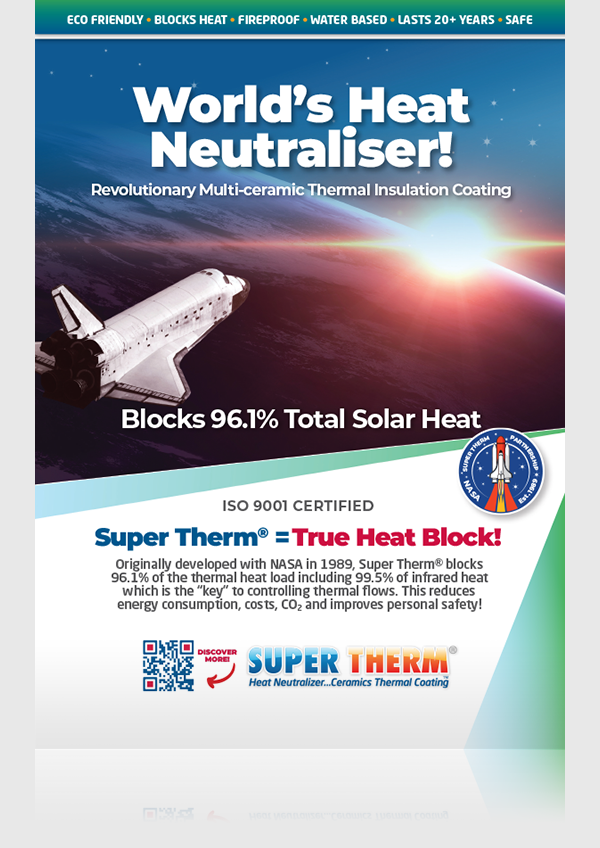
- 96.1% total solar heat reduction
- Low thermal diffusivity
- Low density multi-ceramic structure
- Controlled emissive behaviour
One of its proprietary ceramic compounds is extraordinarily low in density. This reduces surface heat loading capacity and limits energy absorption at the boundary layer.
The coating interrupts heat before it enters the substrate.
That is the critical difference.
Radiative cooling coatings primarily manage what happens after heat is absorbed.
Super Therm® manages what happens before heat loads.
Pros and Cons
Radiative Cooling Systems
Pros:
- Excellent peak summer performance in consistently hot climates
- Strong daytime heat rejection
Cons:
- High emissivity can increase winter heat loss
- Can increase night-time cooling beyond desirable levels
- Often optimised for laboratory summer metrics
Traditional Reflective Paints
Pros:
- Reduce some solar absorption
- Lower cost
Cons:
- Limited infrared blocking
- Minimal impact on thermal diffusivity
- Little control of seasonal behaviour
Super Therm® Insulation Coating
Pros:
- Blocks heat across the solar spectrum
- Reduces peak temperature
- Reduces night-time heat collapse
- Dampens temperature swing
- Reduces dew-point crossing events
- Performs in mixed climates
Cons:
- Not designed to achieve extreme sub-ambient cooling
- Requires correct application thickness
- More technically sophisticated than simple reflective coatings
In other words, it is not chasing a headline temperature drop.
It is delivering year-round stability.
Honest Technical Assessment
The PRDC research is high-level academic work and represents genuine advancement in radiative cooling science. Super Therm® has been in the field active since 1989 and it operates the same today. Still very much advanced for its time and field.
However:
- It confirms winter overcooling is real
- It confirms condensation/frost risk is real
- It confirms buffering is required
- It acknowledges trade-offs.
Super Therm® is not a PDRC. It is not designed for sub-ambient cooling. It is designed for surface thermal stability across seasons.
That is not a minor distinction.
It is a different thermodynamic philosophy.
Compare the Performance…Compare the Simplicity
PDRC coatings are engineered to maximise net outward radiative flux by combining very high solar reflectance with very high emissivity in the atmospheric window, driving strong heat rejection and, in some cases, sub-ambient cooling. That approach optimises cooling intensity but increases sensitivity to clear winter skies and night-time heat loss, often requiring thermal energy storage to stabilise performance.
Super Therm® operates differently: it focuses on preventing solar heat loading at the surface, blocking infrared energy before absorption and reducing thermal diffusivity to dampen transient temperature swings. Rather than maximising radiative emission, it moderates heat exchange, resulting in smaller peak-to-trough surface temperature amplitude and more stable year-round surface behaviour without auxiliary storage systems.
The Only True Insulation Coating?
Most so-called “insulation paints” rely on reflectance claims or hollow microspheres without measurable heat blocking across the full spectrum.
Super Therm® is a multi-ceramic insulation coating developed through structured ceramic compound research, originally in collaboration with NASA engineers. It operates at the radiation stage, modifies surface heat behaviour, and reduces total heat load before conduction becomes dominant.
At 250 microns dry film thickness, it does what bulk systems require centimetres to achieve — but through a different mechanism.
It does not replace all insulation.
It changes the rules at the surface.
And that is why it stands apart.
The Bigger Picture
We can keep chasing the coolest roof at 2pm.
Or we can design for:
- Stability
- Reduced volatility
- Lower condensation risk
- Balanced seasonal performance
- Real-world mixed climates
Radiative cooling has its place.
But intelligent surface control across seasons is a more matured engineering solution.
And in that category, Super Therm® remains the only true insulation coating engineered for full-cycle thermal behaviour – not just summer headlines.