






Difference between Thermal Conductivity and Thermal Diffusivity and Super Therm
Why Thermal Diffusivity Is the Metric That Truly Explains Real Heat Performance
For decades the building and insulation industries have relied on two numbers to describe thermal performance: R-value and K-value. These metrics measure resistance to heat flow and conductivity through a material. They are useful in controlled laboratory conditions, but they were never designed to fully explain what actually happens to heat on a roof, wall or industrial surface exposed to the sun.
The real world behaves very differently from a steady laboratory test.
Roofs heat up rapidly under solar radiation. Metal walls absorb intense infrared energy. Industrial equipment cycles between heating and cooling. Materials are exposed to wind, radiation, and changing environmental conditions.
In these situations, how fast heat moves through a material becomes just as important as how much heat moves through it.
This is where thermal diffusivity becomes a far more meaningful metric.
Instead of simply measuring resistance, thermal diffusivity describes how quickly heat travels through a material after it is exposed to energy.
In practical terms, it explains why two materials with similar conductivity values can behave completely differently in real buildings.
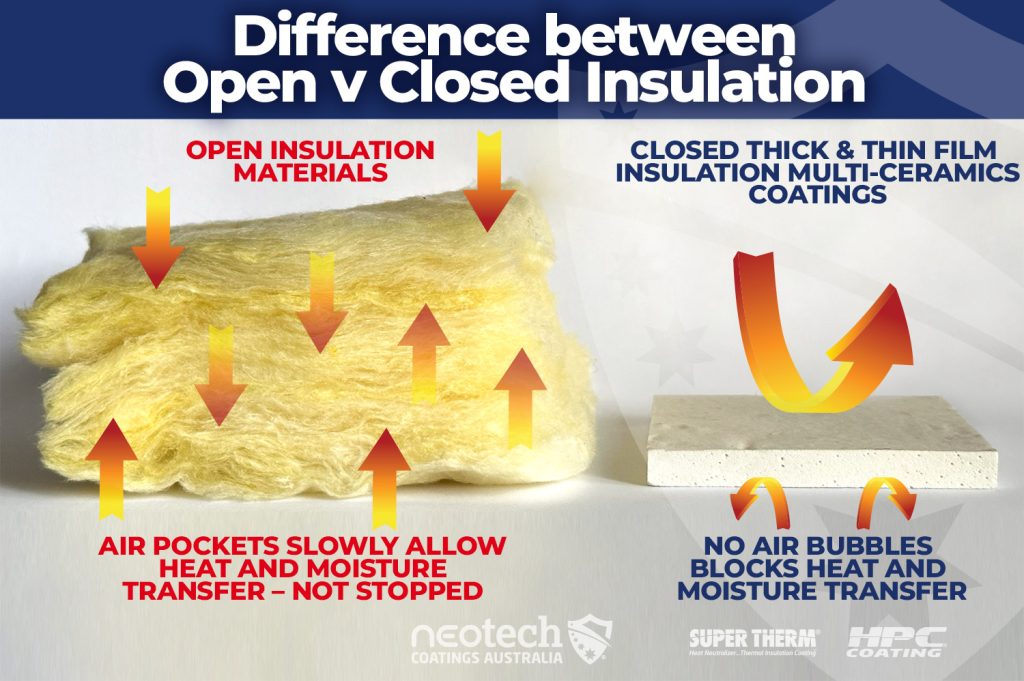
The Problem With R-Value Thinking
R-value measures resistance to heat transfer. It assumes a stable temperature difference across a material. In laboratory testing, heat is applied to one side of a sample while the other side remains at a controlled temperature.
The test then measures how much heat flows through.
This approach works well for materials buried inside a wall cavity, where temperatures change slowly. But it struggles to describe what happens on exposed surfaces such as roofs and walls that face the sun.
Solar radiation does not behave like a steady heater.
The sun delivers energy in three primary wavelengths:
- Ultraviolet radiation
- Visible light
- Infrared heat energy
When this energy hits a surface, several things happen immediately. Some energy is reflected, some is absorbed, and some begins moving through the material.
The key question becomes:
How quickly does that absorbed heat move deeper into the structure?
R-values do not answer that question.
Thermal diffusivity does.
What Thermal Diffusivity Actually Measures
Thermal diffusivity combines several physical properties of a material:
- Thermal conductivity
- Density
- Specific heat capacity
These combine into a single metric that describes how quickly temperature changes propagate through a material.
In simple terms:
High diffusivity = heat moves quickly.
Low diffusivity = heat moves slowly.
Materials such as metals have extremely high diffusivity. Heat travels through them rapidly, which is why a metal roof can become scorching hot within minutes of sun exposure.
By contrast, materials with low diffusivity slow the movement of heat. Energy takes much longer to move through the structure.
This delay dramatically changes the thermal behaviour of a building.
Real World Example: Metal Roofs
Consider a typical metal warehouse roof in Australia.
On a summer afternoon the external roof temperature can exceed 70 °C. Inside the building, workers feel the radiant heat coming through the structure.
Traditional insulation attempts to slow that heat after it has already entered the roof assembly.
But the real problem begins on the surface.
A metal sheet has extremely high thermal diffusivity. Heat absorbed by the surface moves rapidly through the thin steel layer and radiates downward into the building.
Even if insulation exists below the sheet, the roof itself becomes a massive heat radiator.
Now imagine changing the behaviour of that surface.
If a coating dramatically reduces the rate at which heat moves through the surface layer, the roof stops acting like a thermal amplifier.
Instead of absorbing and transmitting energy rapidly, the surface stabilises.
The building envelope begins to behave differently.
Real World Example: Asphalt and Urban Heat
Cities provide another useful example.
Walk barefoot on asphalt during summer and the heat is immediately obvious. Asphalt has relatively high thermal diffusivity. Solar energy absorbed by the surface quickly spreads through the material and re-radiates into the surrounding air.
This is a major contributor to the urban heat island effect.
Now compare this with surfaces that slow the movement of heat energy.
Materials with lower diffusivity do not transfer absorbed heat as quickly. Surface temperatures stabilise and surrounding air temperatures remain lower.
The difference may seem subtle in theory but in practice it affects:
- Building cooling loads
- Pedestrian comfort
- Urban heat accumulation
- Energy demand
Thermal diffusivity provides the physics behind these real-world outcomes.
Why Surface Behaviour Matters More in a Warming Climate
Climate projections indicate that many regions will experience higher peak temperatures and longer heat events over the coming decades.
Designing buildings for these conditions requires more than simply adding thicker insulation.
The outer surfaces of buildings will experience increasingly intense solar radiation. Controlling how those surfaces interact with heat becomes critical.
This is why the conversation around building performance is shifting toward metrics that describe dynamic heat behaviour, not just static resistance.
Thermal diffusivity is central to this shift.
A surface that slows the movement of heat energy helps stabilise the building envelope before heat penetrates deeper into the structure.
This approach aligns with a broader strategy of managing three key factors on exterior surfaces:
- Reflectance
- Emissivity
- Diffusivity
Together these determine how solar energy is handled the moment it reaches a building.
The Science Thermal Conductivity and Thermal Diffusivity
Thermal Conductivity: Shows how well materials conduct heat. Metals like copper and aluminum have high values, while insulation materials like foam have very low values. Increase of heat sees a lower performance in conductivity values.
Thermal Diffusivity: Shows how quickly materials respond to temperature changes. Even though metals conduct heat well, their diffusivity varies based on density and specific heat. Super Therm prevents heat load and therefore less heat penetrates the surface.
This illustrates that materials with high conductivity don’t always have high diffusivity – it depends on their density and heat capacity.
1. Thermal Conductivity (k)
- Definition: Measures how well a material conducts heat
- Unit: W/m·K (Watts per meter per Kelvin)
- Focus: The material’s ability to transfer heat energy
- Key Factors: Higher conductivity means the material transfers heat more efficiently
- Example: Metals like copper (k ≈ 400 W/m·K) have high conductivity, while insulation materials like foam (k ≈ 0.03 W/m·K) have low conductivity
2. Thermal Diffusivity (α)
- Definition: Measures how quickly a material responds to temperature changes.
- Formula:
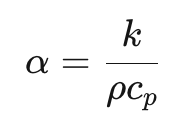
- Where:
- k = thermal conductivity (W/m·K)
- ρ = density (kg/m³)
- cₚ = specific heat capacity (J/kg·K)
- Unit: m²/s.
- Focus: The rate at which heat spreads through a material.
- Key Factors:
- High diffusivity = heats up and cools down quickly.
- Low diffusivity = retains heat longer.
- Example: Metals have high diffusivity, so they heat up and cool down quickly. Concrete has lower diffusivity, meaning it retains heat longer.
Key Difference
- Thermal conductivity (k): How well a material transfers heat
- Thermal diffusivity (α): How fast a material reacts to temperature changes
A high k material can conduct heat well, but if it has a high density and heat capacity, its α may be low, meaning it takes longer to heat up.
Super Therm – ASTM E1269 and Thermal Diffusivity test – blocked 99% of the BTU heat load from 367 down to just 4 BTU at 100°C. 0.256 mm2/s on metal plate.
The Role of Thin-Film Insulation Coatings
Advances in ceramic materials have made it possible to engineer coatings that modify the thermal behaviour of surfaces without relying on thickness.
Traditional insulation depends heavily on bulk material depth to create resistance. In contrast, specialised ceramic coatings focus on controlling radiation and slowing the movement of heat energy through the surface layer.
The result is a system that addresses the initial heat load rather than reacting to heat after it has entered the structure.
One example is Super Therm®, a multi-ceramic insulation coating developed through research involving NASA and SPI Coatings in the United States.
Despite a dry film thickness of only 0.25 mm, the coating is designed to manage solar energy across the full radiation spectrum while maintaining extremely low thermal diffusivity.
In practice this means the coating helps stabilise surface temperatures and slows the rate at which heat moves through the building envelope.
Field trials have demonstrated the practical effect of this approach. In the City of Adelaide Cool Roof Trial, buildings coated with Super Therm® recorded internal temperatures up to 6 °C below ambient conditions during hot weather.
The performance was not achieved through thickness, but through surface energy management.
Super Therm® – Stopping Heat Before It Starts
Most insulation materials absorb and conduct heat, leading to heat buildup inside. Super Therm® works differently.
🔵 Traditional insulation relies on thermal conductivity, meaning it absorbs heat and slowly releases it over time—like a hot rock in the sun.
🔴 Super Therm® stops heat at the surface by blocking thermal diffusivity, preventing heat from ever loading in the first place. No absorption, no slow release—just a consistently cooler surface.
The result? No stored heat, no wasted energy, and no reliance on air conditioning to remove trapped heat. That’s why Super Therm® delivers instant heat protection instead of just slowing heat transfer.
Block the heat before it enters, don’t just slow it down. That’s the Super Therm® difference.
For insulation coatings like Super Therm®, a low thermal diffusivity is beneficial – it slows down heat penetration, keeping surfaces cooler longer.
Moving Beyond Old Metrics
R-values and K-values will remain useful tools for certain insulation applications. But they were developed during a period when buildings relied heavily on bulk materials placed inside cavities.
Modern construction increasingly requires solutions that control heat at the exterior surface before it enters the structure.
That shift demands metrics capable of explaining dynamic thermal behaviour.
Thermal diffusivity provides that explanation.
It tells us how quickly heat moves. It reveals why some materials amplify heat while others stabilise surfaces. And it helps designers understand why thin, advanced coatings can influence building performance in ways traditional insulation models struggle to predict.
As buildings adapt to hotter climates and higher energy costs, the industry will need to move beyond simple resistance metrics.
Understanding how heat behaves in motion will become essential.
Thermal diffusivity is one of the keys to that future.
References
ScienceDirect – Thermal Diffusivity Overview
https://www.sciencedirect.com/topics/engineering/thermal-diffusivity
NEOtech Coatings – Difference Between Thermal Conductivity and Thermal Diffusivity
https://neotechcoatings.com/difference-between-thermal-conductivity-and-thermal-diffusivity-and-super-therm/
Engineering Toolbox – Thermal Diffusivity of Materials
https://www.engineeringtoolbox.com/thermal-diffusivity-d_429.html