




Insulating Steel Frames – Prevents Moisture (corrosion) and Thermal Bridging (heat transfer)
Steel Frames Are Not the Problem.
Poor Moisture and Surface Control Is.
There is a growing narrative that steel-framed homes are inherently flawed. They’re not. What’s poorly understood is how exposed steel surfaces behave thermally and in the presence of air and moisture. This article highlights corrosion and condensation issues that stem from that misunderstanding. Unlike timber, steel readily transfers heat, creating thermal bridging that allows solar heat and temperature differentials to move straight into the home – see for more information about thermal bridging.
What is failing is the industry’s understanding of air movement, moisture behaviour, condensation risk, and how insulation actually interacts with steel.
An article by Kellner Lydia on realestate.com.au highlights what many homeowners are now discovering at great cost: premature corrosion in relatively new steel-framed homes. What is being observed is not new, unusual, or mysterious.
It is a residential version of a well-documented industrial failure mode: corrosion under insulation (CUI).
Same physics. Same outcome.
The Physics That Matter (and are being missed)
Steel corrosion in buildings requires three conditions to align:
- An unprotected cold steel surface
- Warm, moisture-laden air
- Sustained moisture presence
In modern homes, warm humid indoor air migrates through wall cavities via pressure differentials, air leakage paths, and vapour diffusion. When that air encounters a cold steel frame, the steel surface temperature drops below the dew point.
Condensation forms directly on the steel.
This is where the problem accelerates.
Why Bulk Insulation Often Makes It Worse
Bulk insulation does not prevent condensation on steel. It does not control surface temperature. It does not block vapour contact.
Bulk insulation relies on trapped air to resist heat flow. Once moisture enters the system, that insulation absorbs and retains water. Instead of protecting the steel, it holds moisture against it.
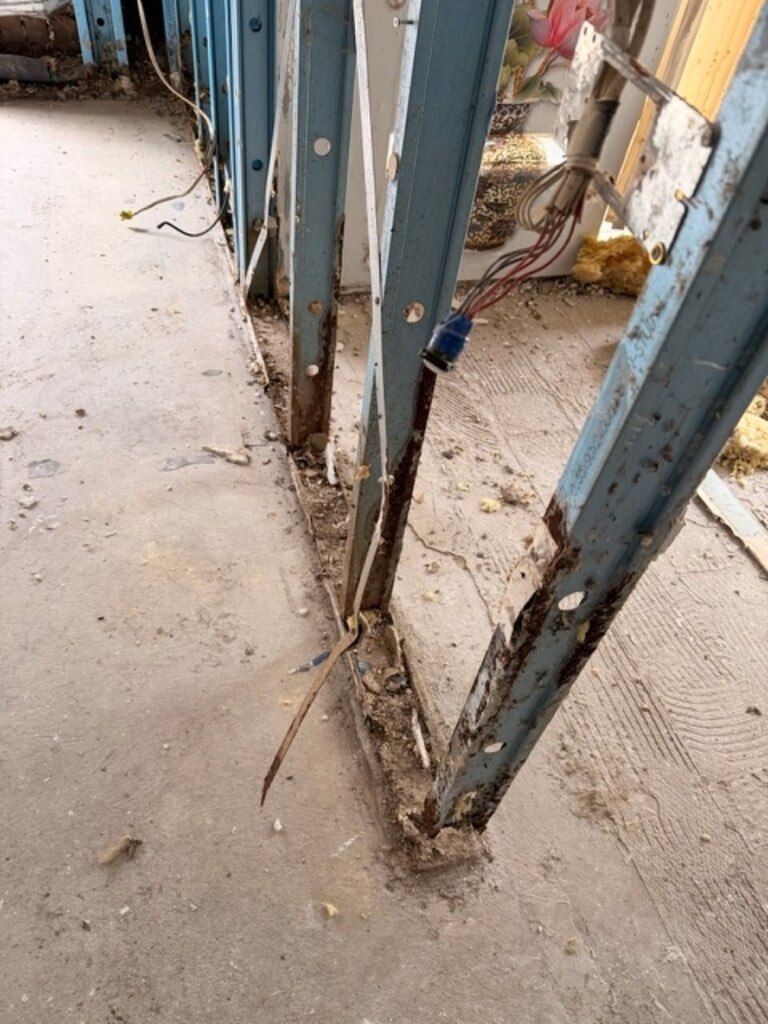
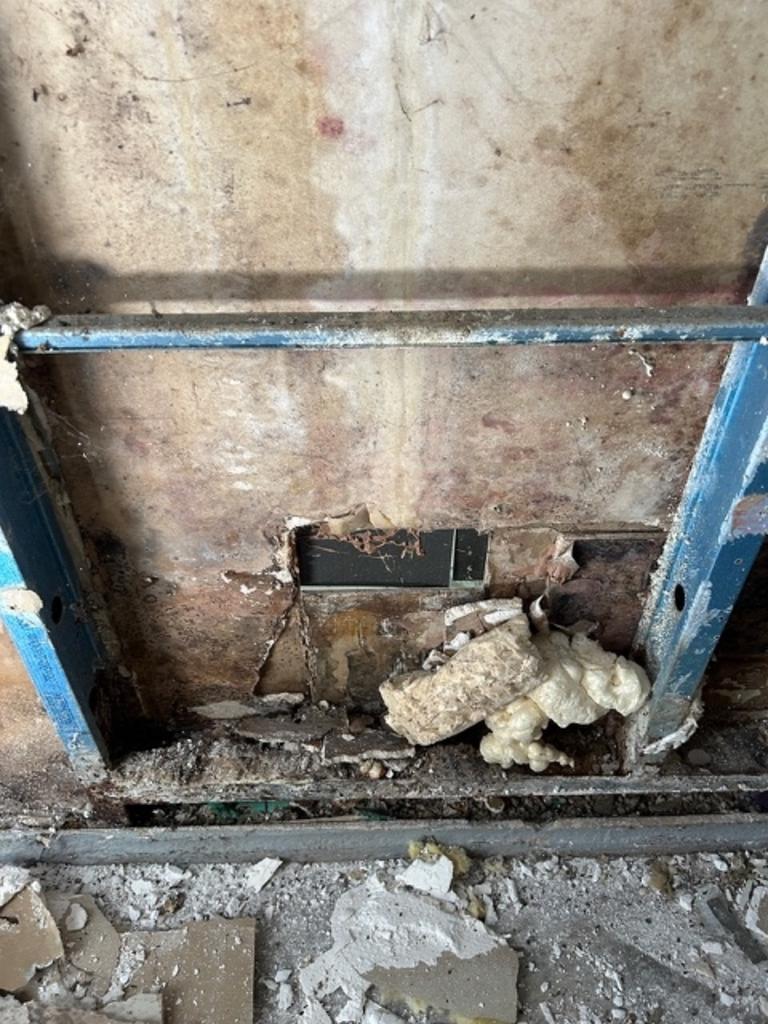
Evidence is often visible long before steel is inspected. Moisture staining on internal linings, such as Gyprock®, is a strong indicator that condensation is occurring behind the wall. What cannot be seen is what is happening deeper in the cavity.
Gravity ensures that moisture migrates downward. At the base of walls, water pools. In cooler climates and over winter, drying potential is minimal. The steel remains wet for extended periods.
This is the exact environment required for corrosion to accelerate — quietly and out of sight.
By the time visible damage appears, the insulation is waterlogged and ineffective, and the steel has been degrading for years.
This is not a material failure.
It is a design and detailing failure.
Bulk insulation relies on trapped air. Once moisture enters, it absorbs and holds that water against the steel. In fact photo 2 below (supplied) shows the moisture staining on the Gyprock®. Drying becomes almost impossible, especially at the base of walls where gravity pulls moisture down. In cooler climates, over winter, the steel and insulation stays wet. Corrosion accelerates out of sight causing a disaster.
 |  |
Steel Frames Can Perform Exceptionally Well — If Treated Correctly
Steel framing, when properly detailed, offers strength, precision, dimensional stability, and long service life. The issue is that steel is rarely protected at the point where failure begins: the surface.
In most residential construction, no meaningful attempt is made at either factory or installation stage to manage:
- Thermal bridging through steel members
- Surface temperature control
- Vapour contact at the steel interface
Instead, the industry relies almost exclusively on bulk insulation, assuming it will solve all thermal and condensation risks. It does not.
How Super Therm® Changes the Outcome
When steel framing is coated with Super Therm®, the thermal behaviour of the surface changes fundamentally. Additionally it protects from thermal bridging, fire and offers acoustic prevention. Condensation does not begin in the insulation.
It begins at the steel surface.
Condensation is a surface temperature vs dew point problem, driven by radiation, convection, geometry and how fast heat moves at the surface. You can add more bulk insulation and still get condensation.
That’s where Super Therm® plays a different role. It doesn’t replace insulation. It reduces the thermal influence at the surface by blocking heat exchange and slowing temperature swings with very low diffusivity. Less surface volatility, less chance of crossing dew point.
The coating acts as a thermal barrier at the steel surface, delivering three critical effects:
- Surface temperature stabilisation
The steel is no longer a cold condensation point when exposed to warm internal air. - Thermal bridge reduction
Heat flow through steel members is significantly reduced, improving summer performance and reducing internal heat gain pathways. - Condensation prevention
By preventing warm, moist air from directly contacting a cold steel surface, the condensation cycle is broken before it starts.
No condensation means no trapped moisture.
No trapped moisture means no corrosion pathway.
This approach mirrors best practice in industrial environments, where CUI has been studied, documented, and engineered out for decades.
When the surface temperature stays above the dew point, condensation does not form. Without condensation, the corrosion cycle cannot start.
This approach mirrors best practice in industrial environments where CUI risks are well understood and proactively managed. The same science applies in residential buildings – it has simply been ignored.
The Missing Layer: Surface Thermal Management
Condensation does not begin in the insulation.
It begins at the steel surface.
This is why surface-based thermal management is critical.
By applying Super Therm® thermal insulation coating directly to the steel, the physics of the system change:
- The steel surface temperature is stabilised
- Thermal bridging is reduced
- Heat flow through the steel is interrupted
- Warm, moisture-laden air is prevented from directly contacting a cold steel surface
When the surface temperature stays above the dew point, condensation does not form. Without condensation, the corrosion cycle cannot start.
This approach mirrors best practice in industrial environments where CUI risks are well understood and proactively managed. The same science applies in residential buildings — it has simply been ignored.
The Real Issue the Industry Avoids
The industry has focused almost exclusively on R-values, cavity insulation and compliance checklists, while ignoring surface physics.
- But insulation does not protect steel
- Air barriers do not protect steel
- Vapour control alone does not protect steel
- Steel is not the enemy
- Insulation is not inherently the solution
- Uncontrolled air, moisture, and unprotected surfaces are the real problem.
Best systems don’t argue R-value vs Coatings. They combine them for solutions.
Only surface temperature control and isolation from moist air prevents condensation at the source.
Until that is addressed, corrosion risk remains embedded in the wall system.
Builders and architects scratching their heads over corroding steel frames are not facing a mystery. They are facing basic building physics that has not been adequately addressed, taught, or required.
Continuing to rely solely on bulk insulation while ignoring surface temperature and vapour contact is a blind spot – and the consequences are proving costly.
This issue is avoidable.
Bulk insulation relies on trapped air. Once moisture enters, it absorbs and holds that water against the steel. In fact photo 2 below (supplied) shows the moisture staining on the Gyprock®. Drying becomes almost impossible, especially at the base of walls where gravity pulls moisture down. In cooler climates, over winter, the steel and insulation stays wet. Corrosion accelerates out of sight causing a disaster.
| |
By the time damage is visible, the insulation is waterlogged and useless, and the steel has been quietly degrading for years.
This isn’t a steel failure. It’s a detailing failure.
Steel frames can actually perform exceptionally well when treated correctly. The key is controlling thermal bridging and preventing condensation at the steel surface in the first place which is never undertaken at either factory or install.
This is where surface-based thermal management really matters.
By coating steel with Super Therm®, the steel is thermally isolated from internal warm air. The surface temperature is stabilised, thermal bridging is reduced (great for summer), and the conditions required for condensation are dramatically minimised. No warm air touching a cold steel surface means no condensation cycle starting and corrosion is prevented.
Builders and architects are scratching their heads over rusting frames aren’t dealing with a mystery. They’re dealing with basic physics that wasn’t addressed early enough nor even fundamentally understood.
Steel isn’t the enemy. Uncontrolled air, moisture, and poor insulation strategies are. While the industry blindly follows the bulk insulation story the blindspot and issues insulation can cause are devastating.
This is avoidable.