




How Non-Shielding Insulative Coatings Are Redefining Below-Grade Asset Protection
A November 2026 – ProCoatings Magazine
By Arin Shahmoradian, Regional Sales Manager; and B.J. Ray, Director of Sales, Senior Project Manager.
Products: HPC® Coating and Moist Metal Grip®
For decades, coatings contractors and pipeline operators have been fighting a battle they often cannot see.
External corrosion is one of the leading causes of pipeline failures, and corrosion under insulation (CUI) is the worst offender. It hides. It works under thermal insulation, eating away at steel for months or years before anyone knows it’s there. By the time it shows up, you’re not patching a coating – you’re dealing with a failure.
Industry data puts CUI at 40-60% of all piping maintenance expenditures in petroleum processing facilities, and the global cost of corrosion runs around $2.5 trillion per year. Oil flowlines and gathering systems get hit hardest, and they’re a nightmare to inspect. The modern contractor’s job isn’t just laying down a barrier – it’s putting down a system that works with the pipeline’s other defenses, not against them.
Not every insulative coating is built for the same job. Thin-film solar-heat coatings keep radiant heat from loading into tank shells and vessels that store light hydrocarbons. Thick-film process-heat coatings do the opposite, slowing heat leaving a hot pipe or vessel while handling CUI and personnel protection in one system. Below-grade insulation is a process-heat application, and it is where the cathodic shielding problem lives.
The Mechanics of Failure and Cathodic Shielding
Below-grade pipelines face two problems at once: Conventional insulation traps moisture, then blocks the cathodic protection (CP) current meant to bail the pipe out. Cellular glass, concrete jacketing, polymeric wraps, polyethylene tape, coal tar most of these are strong electrical insulators.
Here’s how it plays out:
Groundwater gets through the outer jacket, and the insulation holds it against the pipe – a corrosive micro-en-vironment on the steel. The CP system can’t reach it because insulation is in the way. That’s cathodic shielding: The coating has stopped protecting the steel, and the CP can’t reach it to back it up.
As corrosion specialist Dr. Mehrooz Zamanzadeh of Matergenics has noted, up to 85% of external pipeline corrosion happens under disbonded, CP-shielding coatings. His recommendation is direct: Use non-shielding coatings in CP applications.
The Screen Door Effect
A new generation of dual-purpose coatings insulates thermally without shielding CP current. The easiest way to picture it is by thinking about traditional, below-grade insulation as a solid glass door: It keeps the temperature where you want it to be, but it also blocks the wind. In this scenario, the wind is the CP current trying to reach the pipe.
New, non-shielding composites act more like a heavy-duty screen door. The acrylic and low-density ceramic matrix absorbs and dissipates heat, producing a strong thermal barrier. But unlike a thick plastic or polymeric jacket, the insulative matrix itself isn’t a sealed, water-tight wall. Instead, it remains permeable to moisture and the ions that carry CP current. If the corrosion primer underneath is compromised and groundwater reaches the steel, the current can reach that spot through the wetted matrix and keep the steel protected, as opposed to being shut out similarly to how a solid jacket would.
What Testing Showed
It is important to be upfront about what the lab work found: An independent corrosion lab put the system through cathodic disbondment, adhesion, and CP shielding testing. Judged purely as a corrosion coating, the insulative layer didn’t grade well. Instead, it rated poorly for both adhesion and cathodic disbondment. However, that isn’t the job it was intended to do. The result that mattered was that it did not shield CP. The testing looked at the complete assembly – primer, insulative matrix, and topcoat – not the matrix alone.
That’s the trade-off desired from a thermal layer: Allow a proven corrosion primer – a fusion bonded epoxy (FBE) or a cathodic-disbondment-rated epoxy – to handle corrosion protection. Allow the CP system to back up that primer, and let the insulation manage heat without impacting the current. According to the operator, when paired this way, the system serves as a viable alternative to jacketed insulation for buried service.
Application and Architecture
These coatings systems are built in layers, and each does a specific job.
It begins with a corrosion primer (Moist Metal Grip®), a standard FBE at its normal mill thickness, or – for field repairs and tie-ins – a cathodic-disbondment-rated, two-part epoxy at a minimum of 25 mils (635 microns). Next is an acrylic-based, thick-film insulative coating to handle thermal resistance (HPC® Coating).
The thickness at which this coat is applied depends on service temperature and location. For example, a fuel-gas line in Houston, Texas, requires far less insulative coating than such a line in Duluth, Minn., where colder ground temperatures demand more from the coating. Field applications typically range from 300 mils (7,620 microns) in moderate climates to 500 mils (12,700 microns) or more in colder regions. To withstand soil stress and backfill, the core is wrapped in a polyester mesh embedded between coats and sealed with a marine-grade, amine epoxy topcoat that acts as a moisture barrier.
Because the system bonds directly to the substrate, there is no annular airspace where water may pool – a gap that jacketed systems can never fully close. As it is liquid-applied, it also conforms to flanges, elbows, and valves that rigid jackets cannot easily fit.
Field Experience
A 2020 situation involving a glycol-water line in Wyoming – in which 600 linear feet (~183 m) of NPS (DN 100) pipe was coated at 300 mils (7,620 microns) for winter freeze protection – demonstrates well what coatings contractors should plan to experience in the field.
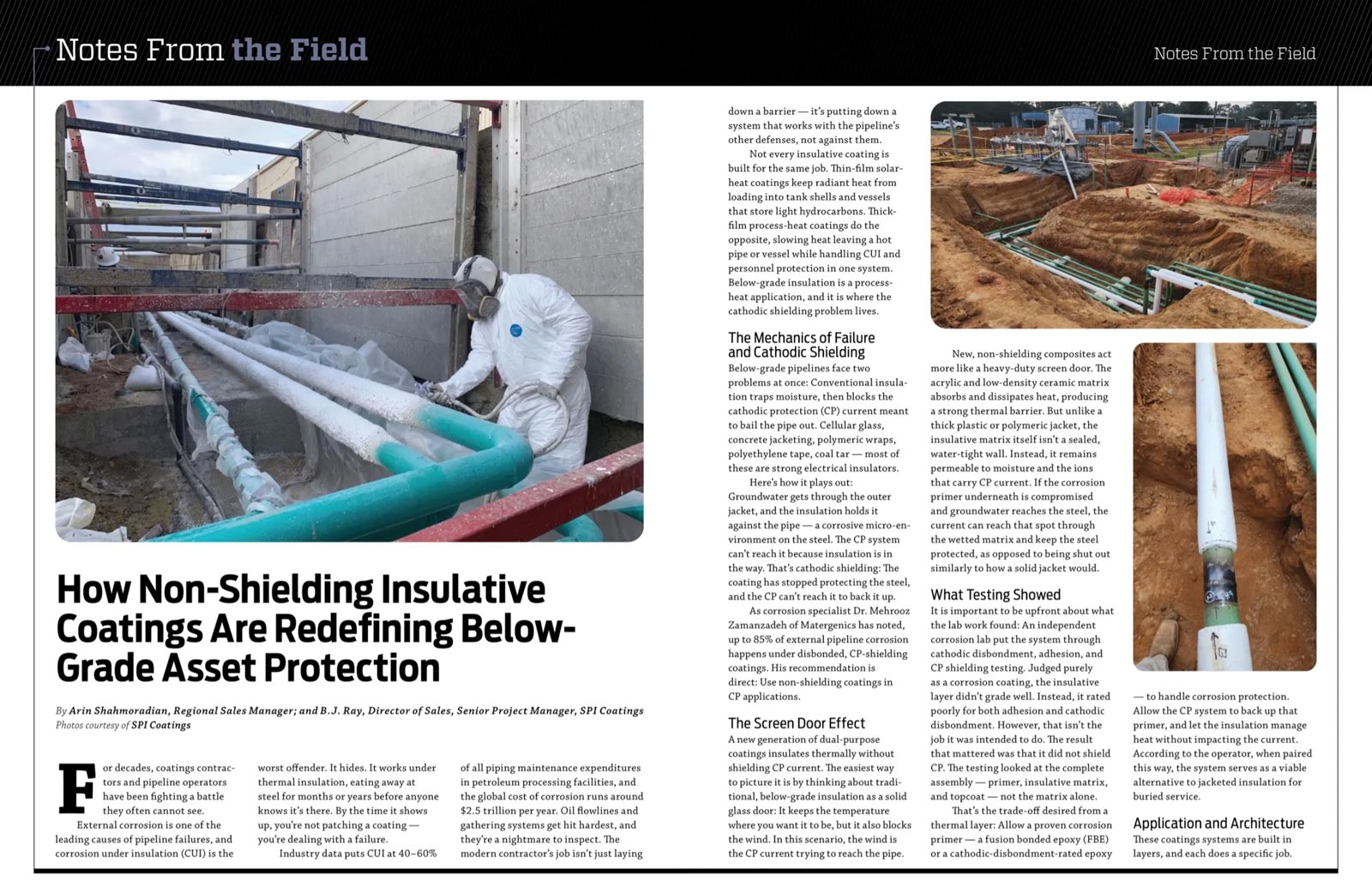
Crews exposed the pipe and lined the trench before abrasive blasting the pipe to repair damaged FBE. They applied a cathodic-disbondment-rated epoxy primer and performed holiday testing. A buildup of thick-film insulative was applied using a texture sprayer.
A moisture meter confirmed that each coat dried below 5% – the correct cure check for a water-based coating – prior to applying the subsequent layers. Hot glycol that recycled through the pipe drove the cure from the inside out. The trench was backfilled only after the coatings had fully cured.
In the years since, the operator has returned to the jobsite multiple times and dug to reveal targeted spots on the pipe. They discovered clean steel under the coating each time, with no under-coating corrosion. That’s the tell: If the system had been shielding CP, the digs would have turned up the same packed rust that would have been found under a failed wrap.
In another example, a fuel-gas line in Minnesota that experienced severe CUI from CP shielding under a conventional wrap was rebuilt with the same architecture and coated at 500 mils. The before-and-after tells the story: Packed rust was discovered under the failed wrap on one end of the line, while a clean, monolithic coating was seen on the other.
Field First, Shop Second
Most maintenance occurs on active lines, and insulative coating technology was built for field applications. Shop applications are a useful alternative during winter-weather emergencies. For example, a pre-primed pipe section from a separate Minnesota project missed its insulation before welding and was shipped via truck to a shop. It was coated indoors and returned, ready to drop into the trench.
Standards and Inspection
Contractors should understand the standards against which insulative coatings are measured.
Thermal performance is confirmed via ASTM C177, a guarded-hot-plate laboratory method that measures steady-state heat flux and thermal conductivity of a flat specimen of the coating material. Personnel protection is evaluated in accordance with ASTM C1055, which defines the maximum acceptable surface temperature for a given contact time (commonly five seconds); surface temperature is measured with a contact thermometer or calibrated infrared instrument, not by hand contact.
Meanwhile, baseline corrosion resistance is screened using salt-spray fog testing (ASTM B117). This controlled, accelerated screening test is used to compare coating systems against one another, but not as a stand-in for the same real-world conditions that would be experienced if the pipe was buried underground.
Inspection changes may also be affected. Because the coatings system bonds directly to the substrate, long-range guided-wave ultrasonic testing (GWUT) can screen a lengthy run of pipe from one dig point, though thick insulation shortens its range. Therefore, it is a first-pass screen, but not a cure-all.
When a potential issue is flagged, a targeted dig with pulsed eddy current can be used to measure wall thickness directly through the coating without having to remove it. That combination is superior to blind, sched-ule-based digging and may also reduce costs associated with staying ahead of corrosion.
The coatings industry is moving past traditional jacketing. Below-grade work shows CUI and cathodic shielding can be tackled with better materials engineering – not only by working around an aged system, but by replacing it with one that insulates pipes without blocking cathodic protection. The proof isn’t a lab claim or an analogy- it is reflected when a pipe is dug up following years spent underground and discovering no corrosion.
For contractors, mastering these multi-layered field applications means cleaner work, faster installation, and long-term savings for the operators they serve. The trench is still where their work happens. The difference now is what goes into it.
Arin Shahmoradian is regional sales manager at SPI Coatings. He has 16 years of experience in insulative coatings.
B.J. Ray is director of sales and senior project manager at SPI Coatings. He has 23 years of coatings industry experience.
For more information, contact: www.spicoatings.com