Australian consumers only : USA & World enquires & information visit spicoatings.com - Authorised Australian & New Zealand Distributor


Walk outside on a 35°C day.Touch a dark metal roof. It is not 35°C. It is 60°C, 70°C, sometimes more.…

Most insulation conversations ignore one hard truth. The substrate matters. Metal, concrete and wood do not behave the same under…

Most people still believe insulation must be thick to work. Batts. Boards. Foam. Layers of material measured in tens or…

Most buildings don’t fail because of insulation thickness. They fail because of timing. Thermal inertia and lag time are where…

Most conversations about building comfort revolve around insulation thickness and R-values. That is only part of the story. Comfort is…

If you do not understand how heat actually reaches a building, you will never control it. Most discussions around insulation…

The industry is trained to think thicker equals better. More R-value. More bulk. More layers. But thickness only addresses one…

Most insulation conversations are built on one assumption. That insulation works by absorbing heat. It does not! And that misunderstanding…

In the late 1980s, satellites were picking up something most building codes still ignore. Cities were glowing. Roofs, roads, metal…

The Problem Most People Miss Heat does not move one way. It transfers through radiation, conduction and convection. Most “cool…

Most of the building industry still worships R-value. Higher number. Thicker insulation. Problem solved. That logic worked in the 20th…

Most building conversations focus on R-values, insulation thickness and HVAC capacity. But the real fight starts at the surface. Surface…

Cool roofs are being pushed hard. White surfaces. High reflectance. Lower surface temperatures. Reduced urban heat. All valid. But most…

Most buildings are designed to manage heat after it is already inside. Air conditioning systems grow larger. Energy bills climb.…

The market is shifting. Energy is expensive. Carbon is regulated. Tenants are informed. Investors are cautious. And buildings that overheat…

Most of the buildings and industrial assets operating today were never designed for 45°C heatwaves, extended UV exposure, rising energy…

What Actually Matters When Heat and Flame Are Involved Fire performance is one of the most misunderstood parts of building…

Every coating system eventually faces the same test. Sun. Moisture. Movement. Contamination. Time. The real question is not whether a…

Passive Cool Roofs That Cut Heat Load Before It Enters Your Building A cool surface is not a new idea.…

The U.S. Energy Authority has long promoted reflective or “cool roof” technologies as a way to reduce solar heat gain…

A report titled “Impact of Roof Colour and Insulation on Thermal and Energy Performance of Residential Buildings” produced by Deakin…

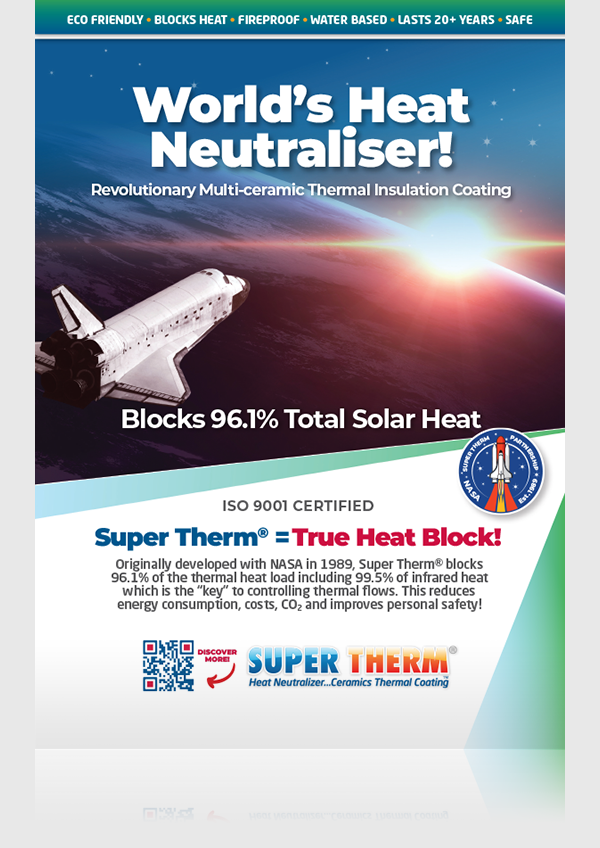
Super Therm® is a multi-ceramic heat-blocking insulation coating designed to reduce solar heat load on exposed surfaces. When applied to…

In the insulation world, spray foam is often promoted as the ultimate solution. It delivers high R-value per inch, excellent…

“Nano ceramic technology.”“Insulative ceramic particle.”“Advanced ceramic coating.” The language sounds precise. It sounds engineered. It sounds proven. It sounds authentic.…

Thermal bridging is one of the most underestimated causes of energy loss in buildings. It does not matter how thick…

Laboratory testing matters. ASTM data matters. Controlled conditions matter. But buildings do not operate in laboratories. They operate in Adelaide…
Walk outside on a 35°C day.Touch a dark metal roof. It is not 35°C. It is 60°C, 70°C, sometimes more.…
Most insulation conversations ignore one hard truth. The substrate matters. Metal, concrete and wood do not behave the same under…
Most conversations about building comfort revolve around insulation thickness and R-values. That is only part of the story. Comfort is…
If you do not understand how heat actually reaches a building, you will never control it. Most discussions around insulation…
Most insulation conversations are built on one assumption. That insulation works by absorbing heat. It does not! And that misunderstanding…
In the late 1980s, satellites were picking up something most building codes still ignore. Cities were glowing. Roofs, roads, metal…
Most of the building industry still worships R-value. Higher number. Thicker insulation. Problem solved. That logic worked in the 20th…
Most buildings are designed to manage heat after it is already inside. Air conditioning systems grow larger. Energy bills climb.…
The market is shifting. Energy is expensive. Carbon is regulated. Tenants are informed. Investors are cautious. And buildings that overheat…
Most of the buildings and industrial assets operating today were never designed for 45°C heatwaves, extended UV exposure, rising energy…
What Actually Matters When Heat and Flame Are Involved Fire performance is one of the most misunderstood parts of building…
Every coating system eventually faces the same test. Sun. Moisture. Movement. Contamination. Time. The real question is not whether a…

Heat blocking coatings work. But only when they are installed correctly. Too often, performance gets judged on the product when…

What Actually Proves Performance? In the coatings and insulation industry, everyone claims performance. Energy savings. Heat reduction. Fire resistance. Durability.…

Thermal cameras do not guess. They measure infrared radiation and convert it into a visible temperature map. When used correctly,…

There’s a big gap between what a product says it does and what it can actually prove. In the coatings…

Most people look at one number and think they understand performance. That is the mistake. Solar reflectance reports are technical…

In building science, the lab is controlled. The surface is not. In the lab, temperature, humidity, air movement and radiation…

Government field trials carry weight. They are independent, structured, and often influence policy, funding and specification decisions. But they are…

There is a lot of noise in the insulation coatings space. Big claims. Impressive percentages. Selective test data. If you…

Why surface science must now shape planning law Urban heat is no longer a design inconvenience. It is a public…

Energy ratings were built for a different era. They measure compliance. They don’t measure real-time solar punishment on a surface…
If you do not understand how heat actually reaches a building, you will never control it. Most discussions around insulation…
Cool roofs are being pushed hard. White surfaces. High reflectance. Lower surface temperatures. Reduced urban heat. All valid. But most…
The market is shifting. Energy is expensive. Carbon is regulated. Tenants are informed. Investors are cautious. And buildings that overheat…
Most of the buildings and industrial assets operating today were never designed for 45°C heatwaves, extended UV exposure, rising energy…
Heat blocking coatings work. But only when they are installed correctly. Too often, performance gets judged on the product when…

Thickness has dominated insulation thinking for decades. More bulk. More R-value. More material. But what if performance is not about…

If film thickness is wrong, performance is wrong. It’s that simple. In high-performance coatings, especially insulation and corrosion systems, dry…

Coatings do not fail because of chemistry.They fail because of surfaces. You can have the most advanced insulation or corrosion…

Everyone talks about performance on day one. Very few talk about performance after year ten. In building science, coatings and…
What Actually Proves Performance? In the coatings and insulation industry, everyone claims performance. Energy savings. Heat reduction. Fire resistance. Durability.…
Thermal bridging is one of the most underestimated causes of energy loss in buildings. It does not matter how thick…
Laboratory testing matters. ASTM data matters. Controlled conditions matter. But buildings do not operate in laboratories. They operate in Adelaide…
Walk outside on a 35°C day.Touch a dark metal roof. It is not 35°C. It is 60°C, 70°C, sometimes more.…
Most insulation conversations ignore one hard truth. The substrate matters. Metal, concrete and wood do not behave the same under…
Most people still believe insulation must be thick to work. Batts. Boards. Foam. Layers of material measured in tens or…
Most conversations about building comfort revolve around insulation thickness and R-values. That is only part of the story. Comfort is…
If you do not understand how heat actually reaches a building, you will never control it. Most discussions around insulation…
The industry is trained to think thicker equals better. More R-value. More bulk. More layers. But thickness only addresses one…
Most insulation conversations are built on one assumption. That insulation works by absorbing heat. It does not! And that misunderstanding…
In the late 1980s, satellites were picking up something most building codes still ignore. Cities were glowing. Roofs, roads, metal…

The Problem Across Australia and New Zealand, thousands of buildings are operating under ageing metal roofs. Warehouses. Schools. Modular buildings.…

Extreme heat is not a theory problem. It is a surface problem. Roofs hitting 70°C. Steel containers becoming ovens. Jet…
Why surface science must now shape planning law Urban heat is no longer a design inconvenience. It is a public…

We are not designing for yesterday’s climate anymore. Australia is already experiencing longer heatwaves, higher peak temperatures, intense rainfall events…

For decades, building performance has been judged by a narrow set of metrics. Mostly R-values. Sometimes U-values. Occasionally energy modelling…

Social housing is meant to protect the most vulnerable. Yet across Australia and globally, many social housing projects are thermally…

Where They Succeed and Where They Fall Short Cool roof policies are now embedded in building codes across the US,…

We are still modelling buildings like heat moves slowly and predictably. It doesn’t. In Australia and similar climates, the real…

The problem Most building codes are built around one core idea: slow heat flow through a material. That means R-values,…

Container homes look simple. Steel box. Line it. Insulate it. Done. That’s the myth. In reality, a shipping container is…
Most people still believe insulation must be thick to work. Batts. Boards. Foam. Layers of material measured in tens or…
If you do not understand how heat actually reaches a building, you will never control it. Most discussions around insulation…
The industry is trained to think thicker equals better. More R-value. More bulk. More layers. But thickness only addresses one…
Most insulation conversations are built on one assumption. That insulation works by absorbing heat. It does not! And that misunderstanding…
Most of the building industry still worships R-value. Higher number. Thicker insulation. Problem solved. That logic worked in the 20th…
Most building conversations focus on R-values, insulation thickness and HVAC capacity. But the real fight starts at the surface. Surface…
Most buildings are designed to manage heat after it is already inside. Air conditioning systems grow larger. Energy bills climb.…
The market is shifting. Energy is expensive. Carbon is regulated. Tenants are informed. Investors are cautious. And buildings that overheat…
Most of the buildings and industrial assets operating today were never designed for 45°C heatwaves, extended UV exposure, rising energy…
What Actually Matters When Heat and Flame Are Involved Fire performance is one of the most misunderstood parts of building…
In the insulation world, spray foam is often promoted as the ultimate solution. It delivers high R-value per inch, excellent…
“Nano ceramic technology.”“Insulative ceramic particle.”“Advanced ceramic coating.” The language sounds precise. It sounds engineered. It sounds proven. It sounds authentic.…
Thermal bridging is one of the most underestimated causes of energy loss in buildings. It does not matter how thick…
Laboratory testing matters. ASTM data matters. Controlled conditions matter. But buildings do not operate in laboratories. They operate in Adelaide…
Walk outside on a 35°C day.Touch a dark metal roof. It is not 35°C. It is 60°C, 70°C, sometimes more.…
Most insulation conversations ignore one hard truth. The substrate matters. Metal, concrete and wood do not behave the same under…
Most people still believe insulation must be thick to work. Batts. Boards. Foam. Layers of material measured in tens or…
Most buildings don’t fail because of insulation thickness. They fail because of timing. Thermal inertia and lag time are where…
Most conversations about building comfort revolve around insulation thickness and R-values. That is only part of the story. Comfort is…
If you do not understand how heat actually reaches a building, you will never control it. Most discussions around insulation…
Laboratory testing matters. ASTM data matters. Controlled conditions matter. But buildings do not operate in laboratories. They operate in Adelaide…
Walk outside on a 35°C day.Touch a dark metal roof. It is not 35°C. It is 60°C, 70°C, sometimes more.…
Most people still believe insulation must be thick to work. Batts. Boards. Foam. Layers of material measured in tens or…
Most buildings don’t fail because of insulation thickness. They fail because of timing. Thermal inertia and lag time are where…
Most conversations about building comfort revolve around insulation thickness and R-values. That is only part of the story. Comfort is…
If you do not understand how heat actually reaches a building, you will never control it. Most discussions around insulation…
Most building conversations focus on R-values, insulation thickness and HVAC capacity. But the real fight starts at the surface. Surface…
Cool roofs are being pushed hard. White surfaces. High reflectance. Lower surface temperatures. Reduced urban heat. All valid. But most…
Most buildings are designed to manage heat after it is already inside. Air conditioning systems grow larger. Energy bills climb.…
Most of the buildings and industrial assets operating today were never designed for 45°C heatwaves, extended UV exposure, rising energy…
Looking to join one of the world’s leading coatings companies. Contact us if you’re a quality applicator looking for new products and markets!



Genuine SPI COATING PRODUCTS can only be purchased from SPI Authorised Representatives displaying the SPI Authorised Logo. Note: All reduced energy claims - results may vary in different conditions and locations.