




Australian consumers only : USA & World enquires & information visit spicoatings.com - Authorised Australian & New Zealand Distributor
Urban heat is not a future problem. It is already driving higher energy demand, worsening heat stress and increasing night-time temperatures in our cities.
If councils want measurable impact, they need to move beyond isolated pilot projects and start managing surface behaviour across entire suburbs.
This is not about one park or one shaded street. It is about heat load at scale.
Most urban heat is created when roofs, roads and facades absorb solar radiation during the day and re-radiate it back into the environment.
Concrete, asphalt and metal store energy. That stored heat then releases into surrounding air, increasing local temperatures and preventing night-time cooling.
NASA satellite work in the 1990s clearly identified built surfaces as major contributors to urban heat islands. The issue is surface absorption, not just air temperature.
If you control absorption, you control heat load.
Traditional “cool roof” strategies often focus only on solar reflectance. That is a start, but reflectance alone does not manage the full radiation spectrum.
Councils should prioritise coatings and materials that:
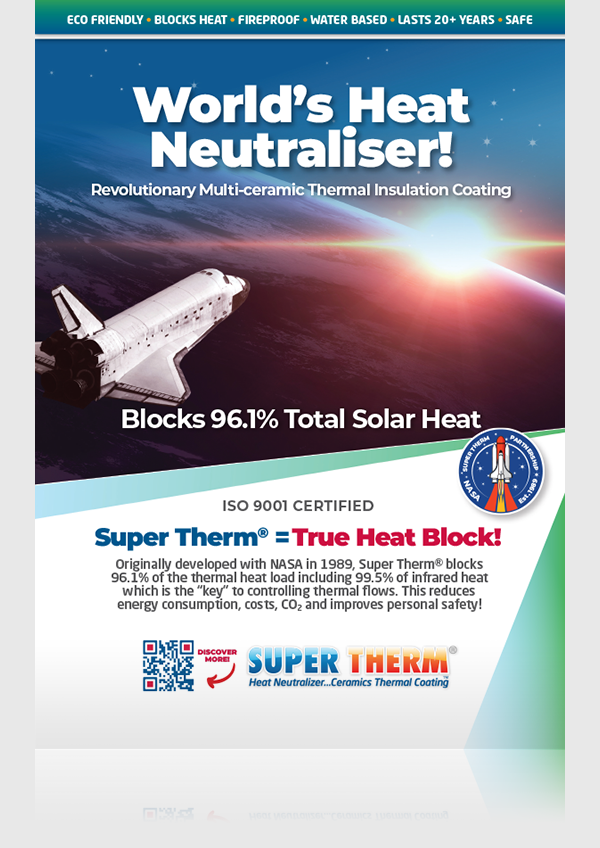
Thin-film ceramic insulation coatings applied at 0.25 mm dry film thickness can block up to 96.1% of total solar heat, including 99% of infrared. That means less heat entering buildings and less re-radiation into surrounding air.
At a council level, this translates to:
Roads and footpaths are massive heat batteries.
Asphalt can reach 60 to 80°C in peak summer conditions. That stored heat radiates well into the evening, contributing to warmer nights.
Local councils control thousands of square metres of exposed surfaces:
Strategic surface coatings that reduce absorption and improve emissive behaviour can significantly cut surface temperatures. Even a 5 to 10°C reduction across multiple precincts materially lowers localised heat islands.
Tree planting programs are essential. They provide:
Studies show trees can reduce pedestrian-level temperatures significantly, particularly in hot dry climates. But trees alone do not stop hard surfaces from absorbing heat in unshaded areas.
The smart approach is integration:
Heat reduction must be embedded in policy.
Councils can implement:
Urban heat is cumulative. Small decisions repeated thousands of times either compound the problem or solve it.
One of the most overlooked issues is night-time heat retention.
When surfaces remain hot after sunset, cities struggle to cool down. This increases health risks during heatwaves.
By reducing daytime absorption, councils improve night-time thermal recovery. That reduces overnight air temperatures and helps vulnerable populations.
Surface science matters more than colour alone.
If councils want measurable results, the formula is straightforward:
Urban heat is not solved with awareness campaigns. It is solved by controlling what absorbs the sun.
Block the heat at the surface, and everything downstream improves.
NEOtech Coatings – Super Therm Testing and Results
https://neotechcoatings.com/super-therm-testing-and-results/
U.S. Environmental Protection Agency – Heat Island Effect
https://www.epa.gov/heatislands
PreventionWeb – Trees are natural ACs for cities
https://www.preventionweb.net/news/trees-are-natural-acs-cities-if-you-plant-right-ones
U.S. Department of Energy – Cool Roofs
https://www.energy.gov/energysaver/cool-roofs

Artificial intelligence, cloud computing and high-density servers are transforming data centres into some of the world’s most energy-intensive facilities. Every watt consumed becomes heat. Every cooling unit generates vibration. Every…

Condensation is one of the most misunderstood problems in buildings and industrial facilities. It is often blamed on poor insulation, inadequate ventilation or even the weather itself. In reality, condensation…

Emergency safety showers are built with one purpose: protect life in seconds. But if the water coming out is above 40°C, you’ve introduced a second hazard into a critical moment.…

There’s a hard truth most of the industry avoids. Grid demand isn’t a generation problem. It’s a heat load problem. Every summer spike, every blackout risk, every surge in energy…

A recent article on cool roofing in hot climates highlights something important: roofs are one of the fastest ways to reduce building heat gain and cut energy bills. In places…

Shipping containers aren’t hard to insulate.They’re hard to stop from overheating. Most builds fail for one reason: they treat insulation as the solution. It’s not. The Problem: You’re Working Inside…

You’re asking the right question. Anyone can sell you a “heat reflective paint.” The real test is what happens after a few summers, constant movement, dust and real-world abuse. Steel…

Fibro cement is everywhere. Affordable, easy to install, and structurally sound. But thermally? It’s weak. It has low thermal mass and low resistance to radiant heat. That means: That’s why…

There’s a growing push in building design toward one idea – continuous insulation. Wrap the building.No gaps.No thermal breaks.Roof to walls to foundation. It’s clean. It’s logical. It complies but…

Concrete block homes are common across Australia. They are strong, durable and affordable. But they have a hidden problem that many homeowners only discover during summer. They store heat. A…

Historic buildings are designed to last centuries. Unfortunately, many were never designed to stay comfortable. Concrete heritage structures are a classic example. They are architecturally important, structurally robust and visually…

Converting a Toyota Coaster bus into a motorhome is a smart project. You gain space, durability and the ability to travel anywhere. But one issue shows up fast once the…

Every summer the same pattern repeats. Temperatures climb. Air conditioners run longer. Electricity demand spikes. And households open their power bill wondering how it got so high. Most advice focuses…

Passive Cool Roofs That Cut Heat Load Before It Enters Your Building A cool surface is not a new idea. What’s new is treating the roof as a thermal management…

The U.S. Energy Authority has long promoted reflective or “cool roof” technologies as a way to reduce solar heat gain in buildings. These systems typically rely on light-coloured surfaces that…

A report titled “Impact of Roof Colour and Insulation on Thermal and Energy Performance of Residential Buildings” produced by Deakin University in collaboration with the Insulation Council of Australia and…

Super Therm® is a multi-ceramic heat-blocking insulation coating designed to reduce solar heat load on exposed surfaces. When applied to metal structures such as aluminium ship and boat roofs, it…

In the insulation world, spray foam is often promoted as the ultimate solution. It delivers high R-value per inch, excellent air sealing, and the ability to fill cavities and irregular…

“Nano ceramic technology.”“Insulative ceramic particle.”“Advanced ceramic coating.” The language sounds precise. It sounds engineered. It sounds proven. It sounds authentic. But ceramics are not a single technology. They are one…

Thermal bridging is one of the most underestimated causes of energy loss in buildings. It does not matter how thick your insulation is.If heat finds a path around it, performance…

Laboratory testing matters. ASTM data matters. Controlled conditions matter. But buildings do not operate in laboratories. They operate in Adelaide summers. Middle East heat. US desert airports. Marine environments. Transportable…

Walk outside on a 35°C day.Touch a dark metal roof. It is not 35°C. It is 60°C, 70°C, sometimes more. Ambient temperature is the air.Surface temperature is radiation plus absorption…

Most insulation conversations ignore one hard truth. The substrate matters. Metal, concrete and wood do not behave the same under solar load. If you do not understand surface science first,…

Most people still believe insulation must be thick to work. Batts. Boards. Foam. Layers of material measured in tens or hundreds of millimetres. Then along comes a coating that cures…

Most buildings don’t fail because of insulation thickness. They fail because of timing. Thermal inertia and lag time are where real performance is won or lost. If you ignore them,…

Most conversations about building comfort revolve around insulation thickness and R-values. That is only part of the story. Comfort is not just about slowing heat flow. It is about how…

If you do not understand how heat actually reaches a building, you will never control it. Most discussions around insulation jump straight to R-values and bulk thickness. That misses the…

The industry is trained to think thicker equals better. More R-value. More bulk. More layers. But thickness only addresses one part of heat transfer. It deals primarily with conductive flow…

Most insulation conversations are built on one assumption. That insulation works by absorbing heat. It does not! And that misunderstanding is costing buildings money, performance and long-term resilience nor planning…

In the late 1980s, satellites were picking up something most building codes still ignore. Cities were glowing. Roofs, roads, metal structures and concrete were absorbing solar radiation all day and…

The Problem Most People Miss Heat does not move one way. It transfers through radiation, conduction and convection. Most “cool roof” products focus on one or two levers. Usually reflectivity…

Most of the building industry still worships R-value. Higher number. Thicker insulation. Problem solved. That logic worked in the 20th century. It won’t work in a future 2050 climate. If…

Most building conversations focus on R-values, insulation thickness and HVAC capacity. But the real fight starts at the surface. Surface heat behaviour determines how much solar energy actually enters the…

Cool roofs are being pushed hard. White surfaces. High reflectance. Lower surface temperatures. Reduced urban heat. All valid. But most coverage stops at the surface and ignores fundamental heat physics…

Most buildings are designed to manage heat after it is already inside. Air conditioning systems grow larger. Energy bills climb. Equipment cycles harder. Maintenance increases. Occupants complain. Asset life shortens.…

The market is shifting. Energy is expensive. Carbon is regulated. Tenants are informed. Investors are cautious. And buildings that overheat are liabilities. A thermally unstable building bleeds money. It relies…

Most of the buildings and industrial assets operating today were never designed for 45°C heatwaves, extended UV exposure, rising energy costs, or aggressive corrosion cycles. Yet that is exactly what…

What Actually Matters When Heat and Flame Are Involved Fire performance is one of the most misunderstood parts of building materials. A product can claim to be “fire resistant,” “non-combustible,”…

Every coating system eventually faces the same test. Sun. Moisture. Movement. Contamination. Time. The real question is not whether a surface will degrade. It is how fast, how predictably, and…

Steel fails for two main reasons. Heat and corrosion. We treat them as separate problems. They are not. If you allow solar radiation to superheat a steel surface, you accelerate…

The Problem Across Australia and New Zealand, thousands of buildings are operating under ageing metal roofs. Warehouses. Schools. Modular buildings. Container offices. The default solution when performance drops is expensive…

Heat blocking coatings work. But only when they are installed correctly. Too often, performance gets judged on the product when the real issue is application. A high-performance coating applied poorly…

Thickness has dominated insulation thinking for decades. More bulk. More R-value. More material. But what if performance is not about thickness at all? A 0.25 mm dry film thickness sounds…

If film thickness is wrong, performance is wrong. It’s that simple. In high-performance coatings, especially insulation and corrosion systems, dry film thickness is not a suggestion. It is a specification…

Coatings do not fail because of chemistry.They fail because of surfaces. You can have the most advanced insulation or corrosion system in the world, but if the substrate is contaminated,…

Application method is rarely discussed in technical detail, yet it directly affects coating performance. Spray and roller are not just different tools. They influence film build, density, surface profile, curing…

Extreme heat is not a theory problem. It is a surface problem. Roofs hitting 70°C. Steel containers becoming ovens. Jet bridges, rail carriages, mining camps and defence assets absorbing solar…

If you are specifying coatings for roofs, steel structures, containers or façades, the real question is simple. Will it still perform in 10, 20 or 30 years? Accelerated weathering exists…

Everyone talks about performance on day one. Very few talk about performance after year ten. In building science, coatings and insulation systems are often assessed on initial lab values. Reflectance.…

What Actually Proves Performance? In the coatings and insulation industry, everyone claims performance. Energy savings. Heat reduction. Fire resistance. Durability. But there is a clear line between manufacturer testing and…

Thermal cameras do not guess. They measure infrared radiation and convert it into a visible temperature map. When used correctly, they expose one simple truth: That difference changes everything for…

There’s a big gap between what a product says it does and what it can actually prove. In the coatings and insulation space, that gap costs money. It costs performance.…

Most people look at one number and think they understand performance. That is the mistake. Solar reflectance reports are technical documents. If you read them properly, they tell you exactly…

In building science, the lab is controlled. The surface is not. In the lab, temperature, humidity, air movement and radiation are isolated and repeatable. On a roof in Adelaide, Dubai…

Government field trials carry weight. They are independent, structured, and often influence policy, funding and specification decisions. But they are also frequently misunderstood. If you do not read them properly,…

There is a lot of noise in the insulation coatings space. Big claims. Impressive percentages. Selective test data. If you want clarity, you need to understand what ASTM and ISO…

Why surface science must now shape planning law Urban heat is no longer a design inconvenience. It is a public health, infrastructure and energy problem. Cities are running hotter because…

We are not designing for yesterday’s climate anymore. Australia is already experiencing longer heatwaves, higher peak temperatures, intense rainfall events and elevated night-time temperatures. Buildings constructed to 1990s logic are…

Energy ratings were built for a different era. They measure compliance. They don’t measure real-time solar punishment on a surface at 2:30pm in January. That gap matters. The Problem: Ratings…

For decades, building performance has been judged by a narrow set of metrics. Mostly R-values. Sometimes U-values. Occasionally energy modelling outputs that look precise but ignore how heat actually behaves…

For decades, the industry has defaulted to thicker insulation, higher R-values and bigger HVAC systems. Yet governments around the world are now testing something far more direct. Control the surface.Control…

Social housing is meant to protect the most vulnerable. Yet across Australia and globally, many social housing projects are thermally fragile. They meet minimum code. They tick the box on…

Where They Succeed and Where They Fall Short Cool roof policies are now embedded in building codes across the US, Europe and parts of Australia. On paper, they make sense.…

We are still modelling buildings like heat moves slowly and predictably. It doesn’t. In Australia and similar climates, the real problem is not winter heat loss. It is rapid solar…

The problem Most building codes are built around one core idea: slow heat flow through a material. That means R-values, U-values and conductivity dominate compliance pathways. If a wall assembly…

Temporary infrastructure is everywhere.Mining camps. Defence facilities. Portable classrooms. Event structures. Site offices. Modular health units. They are fast to deploy. Fast to relocate. And often brutal to occupy. The…

Transportable classrooms are fast to deploy and cost effective. But thermally, they are brutal. Steel skins. Thin walls. Low mass. Full sun exposure. By 10am they are loading heat. By…

Data rooms and electrical switch rooms are not comfort spaces. They are operational risk zones. One temperature spike, one condensation event, one uncontrolled heat load, and you are dealing with…

Shipping container offices are practical, modular and fast to deploy. But thermally, they are brutal. Steel is thin. Steel absorbs radiation fast. Steel transfers heat quickly. In full sun, the…

Container homes look simple. Steel box. Line it. Insulate it. Done. That’s the myth. In reality, a shipping container is a thin steel heat conductor sitting directly in the sun.…

Remote site accommodation is built for speed, cost control and mobility. Not long-term thermal performance. Mining camps, defence bases, oil and gas facilities and modular villages are typically steel-framed, metal-skinned…

Portable buildings are the worst offenders for heat loading.Thin steel skins. Minimal mass. High solar exposure. Little protection from infrared radiation. You can insulate them internally all you like. If…

Steel is the backbone of military infrastructure, mining operations and modular construction. It is strong, adaptable and fast to deploy. It is also one of the worst materials you can…

Shipping containers were never designed for human comfort.They are thin steel shells. Steel has high thermal conductivity. It responds fast to temperature swings. In Australia, that means: When warm, moisture-laden…

Shipping containers were designed to move freight across oceans. Not to be lived in. Not to be offices. Not to sit in 40°C Australian sun. Yet we keep converting them…

We have been trained to believe thicker equals better. Thicker insulation.Thicker walls.Thicker coatings. But in surface thermal science, thickness is often the wrong metric. What matters is how a surface…

A Performance Comparison That Actually Matters The insulation industry has trained everyone to think from the inside out. R-values. Bulk batts. Thickness. Trapped air. But solar heat does not start…

Most people think heat builds up inside a building because the air conditioner is undersized. It doesn’t. The real problem starts earlier. Long before your air conditioner turns on, solar…

Surface temperature is not controlled by thickness alone It is controlled by how the surface handles radiation the moment it arrives. Most materials fail at the surface. They absorb, store,…

The uncomfortable truth You can meet the code.You can tick the R-value box.You can install bulk insulation exactly as specified. And the building can still overheat. This is happening everywhere.…

Most roofs overheat long before internal insulation becomes relevant. The real fight is not inside the ceiling cavity.It is happening in the first few microns of the roof surface. If…

What Actually Protects a Surface? Most of the insulation industry talks about conductivity. Very few talk about diffusivity. That’s a problem. Because when the sun hits a surface, what matters…

The Real Heat Problem No One Talks About Most conversations about solar heat start with brightness. White roofs. Reflective paint. Glare reduction. That is surface thinking. As outlined by the…

For decades, building performance has revolved around insulation thickness and R-values. Important, yes. Complete, no. The dominant force driving overheating is not air temperature. It is solar radiation, particularly near-infrared…
White roofs are everywhere. High solar reflectance. Lower surface temperatures. Ticked compliance boxes. On paper, that looks like progress. In reality, reflectance is only one part of heat transfer. If…
Looking to join one of the world’s leading coatings companies. Contact us if you’re a quality applicator looking for new products and markets!



Genuine SPI COATING PRODUCTS can only be purchased from SPI Authorised Representatives displaying the SPI Authorised Logo. Note: All reduced energy claims - results may vary in different conditions and locations.